PRESS RELEASE
CUBICLE
Aug 3 – Aug 15, 2026
CUBICLE
Cubicle is an ongoing platform at Everard Read Cape Town, giving artists scope to exhibit smaller bodies of artworks and site-specific installations for a two week period.
Part of the Heat Winter Arts Festival.
Visit https://www.heatfestival.org/ to find out more about events happening at the gallery and in other locations.
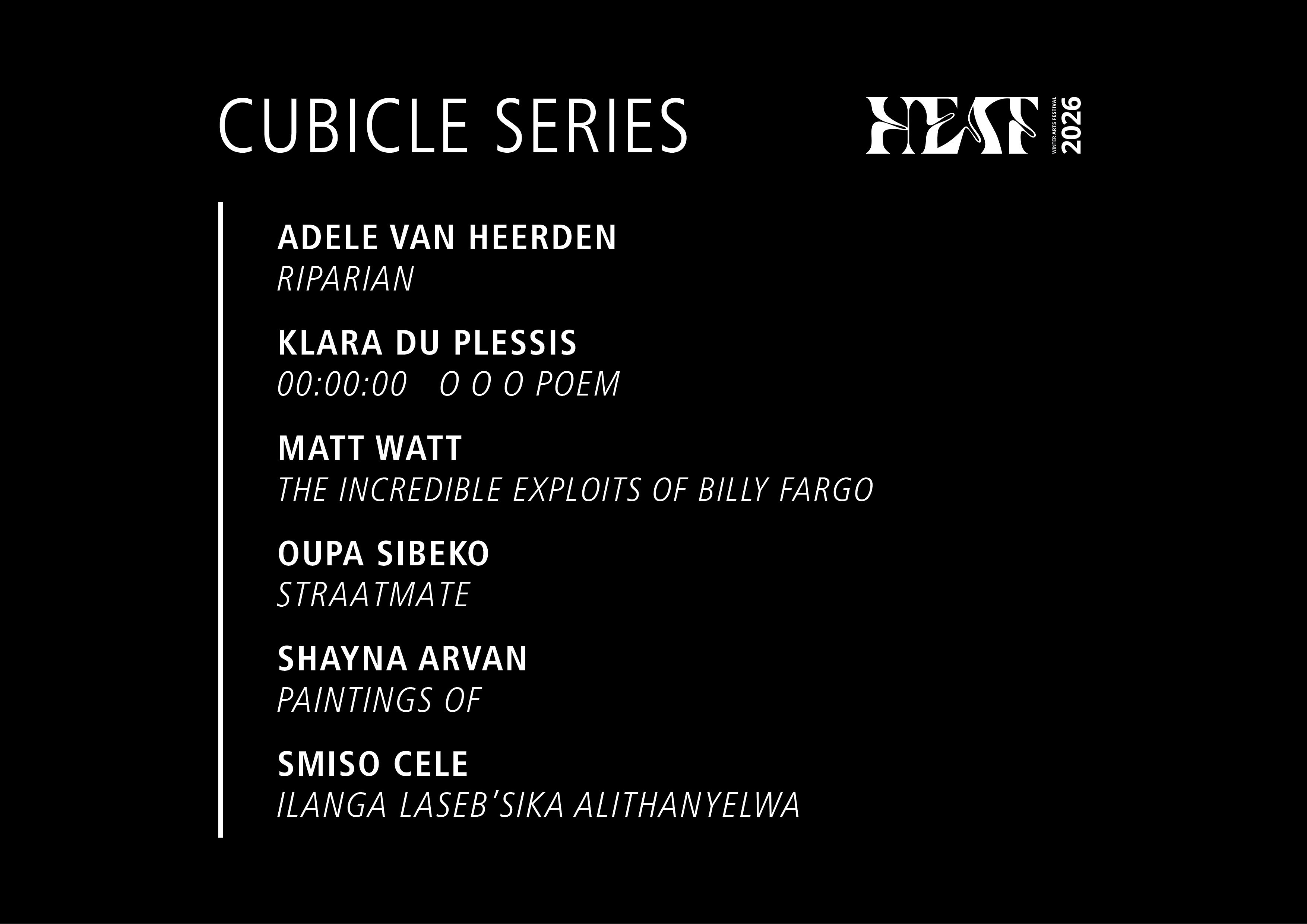
This edition features:
ADELE VAN HEERDEN
RIPARIAN
KLARA DU PLESSIS
00:00:00 O O O POEM
MATT WATT
THE INCREDIBLE EXPLOITS OF BILLY FARGO
OUPA SIBEKO
STRAATMATE
SHAYNA ARVAN
PAINTINGS OF
SMISO CELE
ILANGA LASEB’SIKA ALITHANYELWA
ADELE VAN HEERDEN | RIPARIAN
This series of paintings was developed during Adele van Heerden’s residency at NIROX earlier this year. The work engages the movement of water above and below the Earth’s surface within the Cradle of Humankind. The exhibition comprises paintings made with oil and gouache on linen, alongside a multi-channel sound installation derived from field recordings of water in different locations in the area, as well as photographic work.
With this collection, Van Heerden is particularly drawn to the phenomenon of ‘underflows’: parts of the river’s movement that cannot be seen. Underflows percolate through and influence the layers above – all the way up to what can perceived at the surface – reshaping our relationship with the world and ourselves.
KLARA DU PLESSIS 00:00:00 O O O POEM
In poetry, the exclamation O signifies a turn where the performer physically moves their body away from their primary audience towards a new listener that is absent or abstract. The O thus functions as a hinge that moves between performer and audience to activate and unify the implicit space dividing them, but also to name a presence beyond their centred exchange and to resonate within a gap of ambiguity. This literary move is called apostrophe.
‘00:00:00 O O O Poem’ apostrophises poetry itself. Even as the individual artworks cohere as a solo exhibition within a gallery context, the combined practice of creating these works turns away from a visual tradition to invoke poetry – to focus on Klara du Plessis’s career as a poet –and to amplify the indeterminacy of words in verse. Interrelated through evolving media formats, this body of work further presents itself as a network between page, performance, documentation, and that which has been left unaddressed.
MATT WATT | THE INCREDIBLE EXPLOITS OF BILLY FARGO
Matt Watt is a conceptual artist based in Cape Town. His multidisciplinary practice engages an ongoing interrogation of materiality and gesture within socio-political contexts. Drawing from conceptual art histories, his projects often examine the symbolic residue of media, offshore cultural influence, and imported mythologies, particularly where these structures become absorbed into everyday behavioural and psychological life.
‘The Incredible Exploits of Billy Fargo’ is a reactive body of work that draws on conceptual methodologies to examine how objects, images and gestures acquire meaning through institutional display. Watt uses the visual language of media, nationalism, consumer culture and parody to explore how familiar symbols may become contaminated by the contexts they inhabit.
OUPA SIBEKO | STRAATMATE
Oupa Sibeko brings forth his sense of playfulness yet again with ‘STRAATMATE’. For this body of work, Sibeko underwent an extensive period of research on the history of District Six. He brings the energy of its streets to life through frottage, which involves placing a piece of paper or canvas atop a textured object and rubbing over it with a medium, transferring the textures of the surface onto the substrate.
During his research into the area, Sibeko was struck by the recollections of former residents who spoke of the joy and colour that shaped everyday life there. ‘STRAATMATE’ draws on these recollections, allowing them to exist alongside the weight of history rather than beneath it, emphasising a past that is as much about lived experience as it is about loss. Through play, research and collaboration with the street itself, Sibeko presents artistic practice as something continually shaped by its surroundings rather than confined by them.- Nirel Sithole
SHAYNA ARVAN | PAINTINGS OF
‘Paintings of’ acts as a portal for the imagination. These tiny paintings invite the viewer to linger a little longer, to look, to see, to feel. Even though painting can never capture the reality of an experience, we still try. For some reason these ordinary moments seem worthy of the hours spent painting them. They offer remnants of a life lived; evidence that someone was there, cared, loved, decorated, vandalised, remembered, or tried to preserve what cannot be held directly.
The distance from the object or moment is palpable. We are aware of our inability to reach out and touch the impossibly faraway, ungraspable thing itself, like reaching for memories degraded by the passing of time. In evoking this sensation, Arvan comments on how a painting is not the reference photograph and a photograph in turn is not the moment. Each painting is merely a sign, a substitution for the experience, standing in for reality. There is a hopeful quality in the human impulse to ask one thing to stand in for another – a flower for grief, an engraving for love, a replica for an animal, a photograph for a memory.
SMISO CELE | ILANGA LASEB’SIKA ALITHANYELWA
Cele’s practice manifests across drawing, printmaking and sculpture, and takes inspiration from decolonial gardening practices. Taking into account the contradistinction between gardening as a vocation and domestic gardening, Cele meditates on the opposing politics and historical tradition of labour in each context. This work was produced as an extension of his ongoing project ‘Ebhuqwini’ (loosely referring to a muddy or dusty place), an informal referent for the unfloored room in which he grew up in KwaZulu-Natal, which was shared amongst siblings and doubled as a storage space for gardening tools. This experience engendered a particular relation to objects like the shovel, a recurring feature in his work, not only as something charged with labour but also as a device that evokes memories of home.
We remember things not as they are, but as they were the last time we thought about them. – Jared Leite